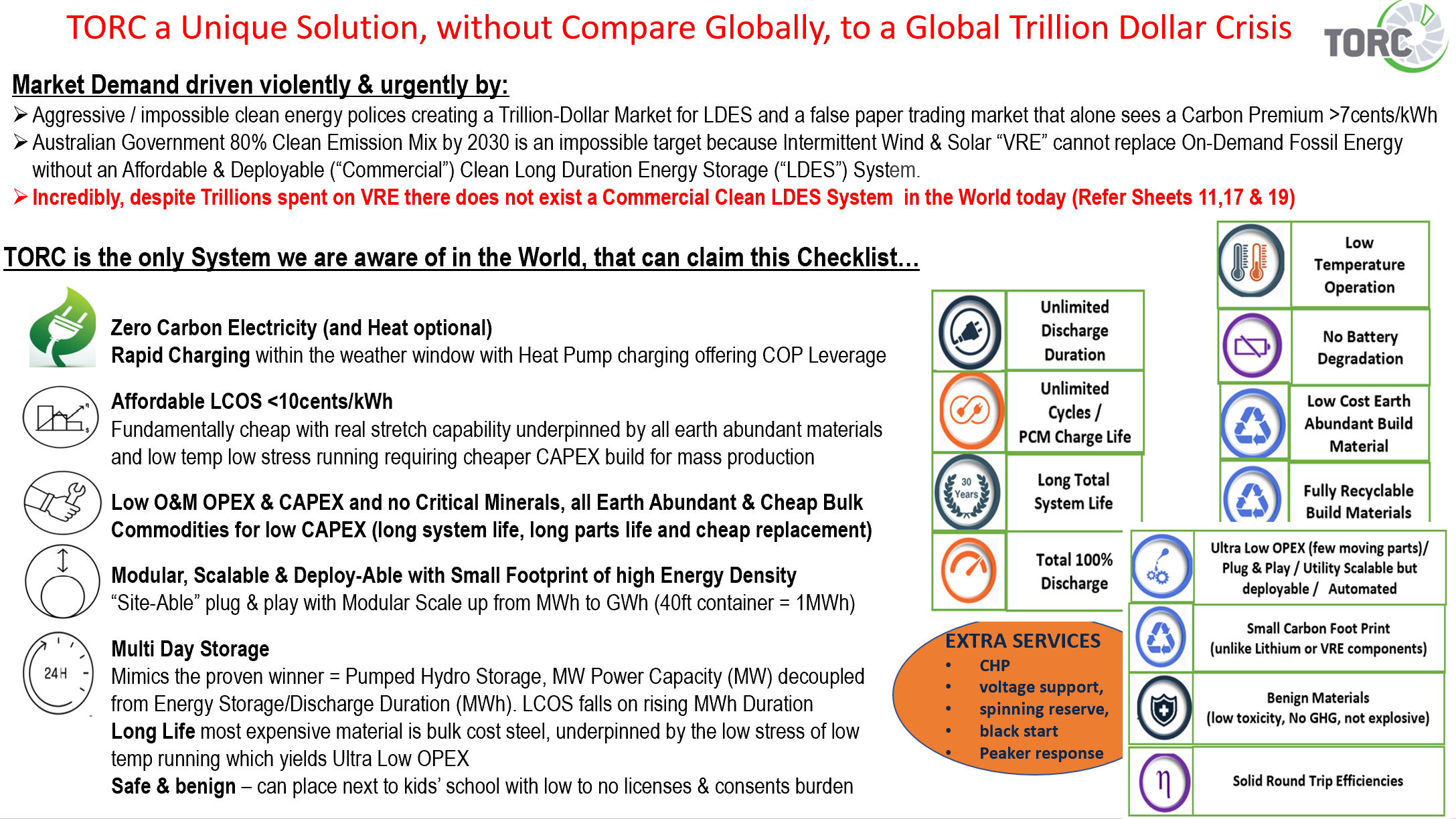
What Clean Affordable Deployable LDES is available in the World presently? ANSWER = NONE.
The Global Benchmark Authority of LDES Systems is the McKinsey LDES Council www.ldescouncil.com TORC was a member of the LDES Council but the Fees were not considered practical.
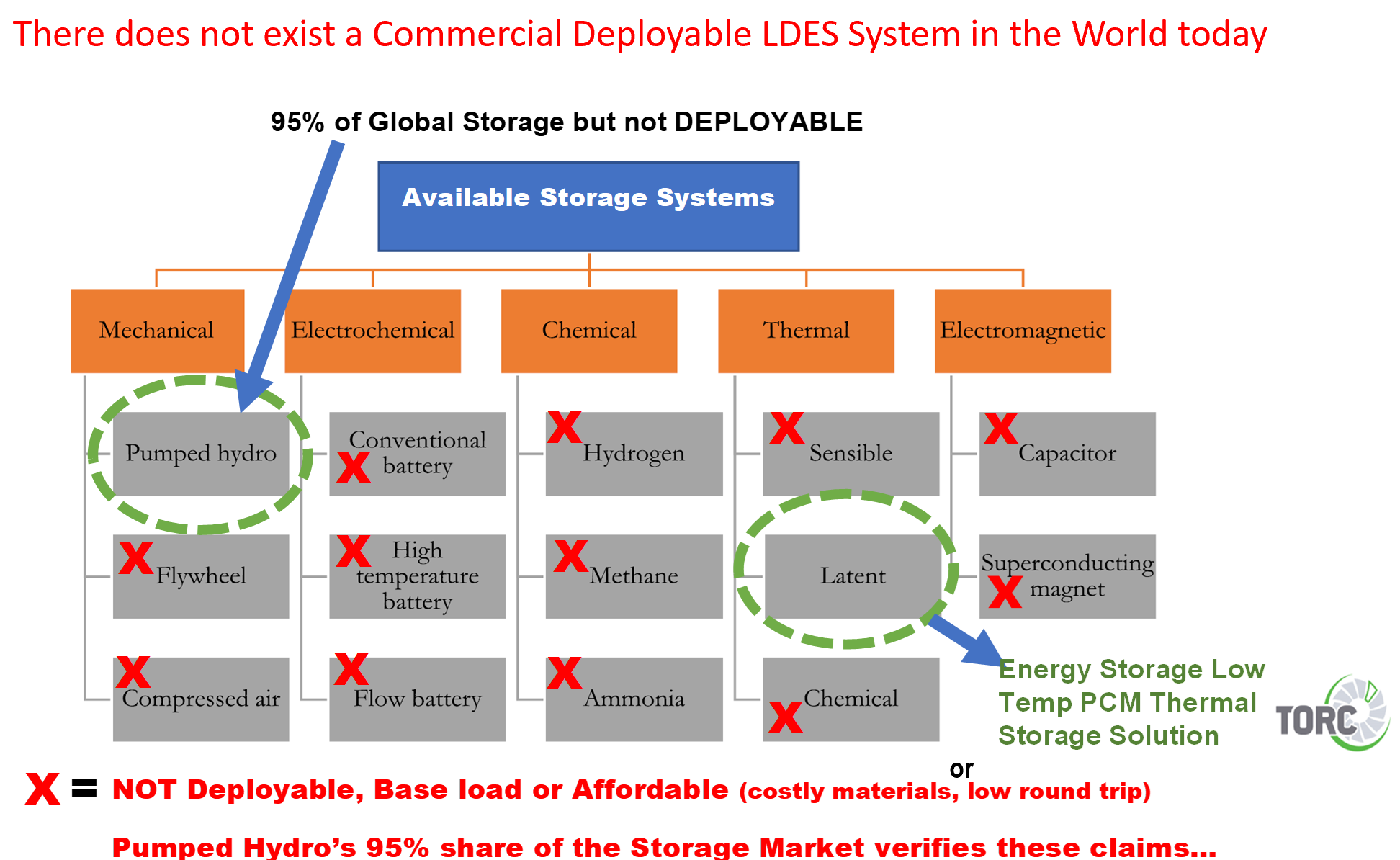
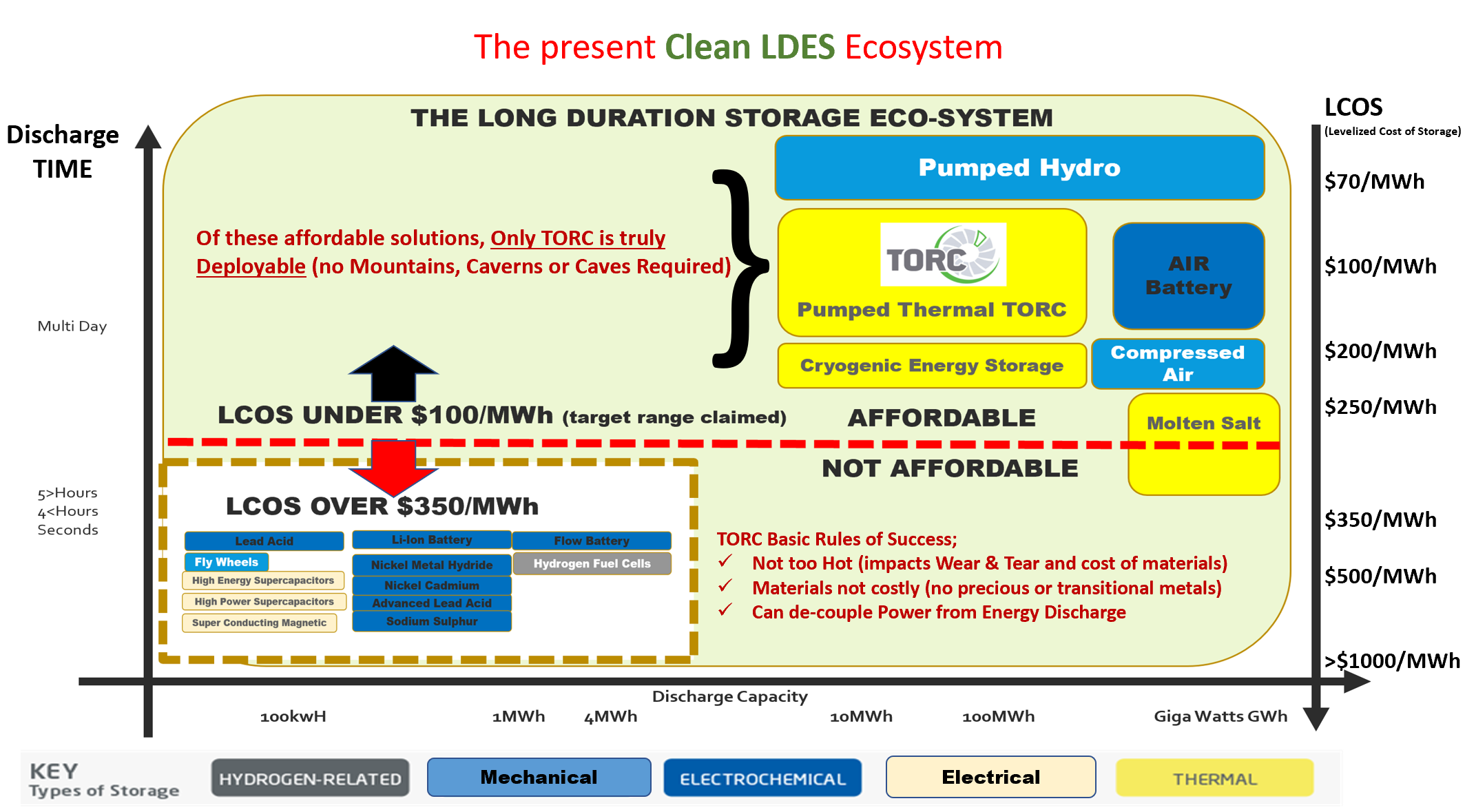
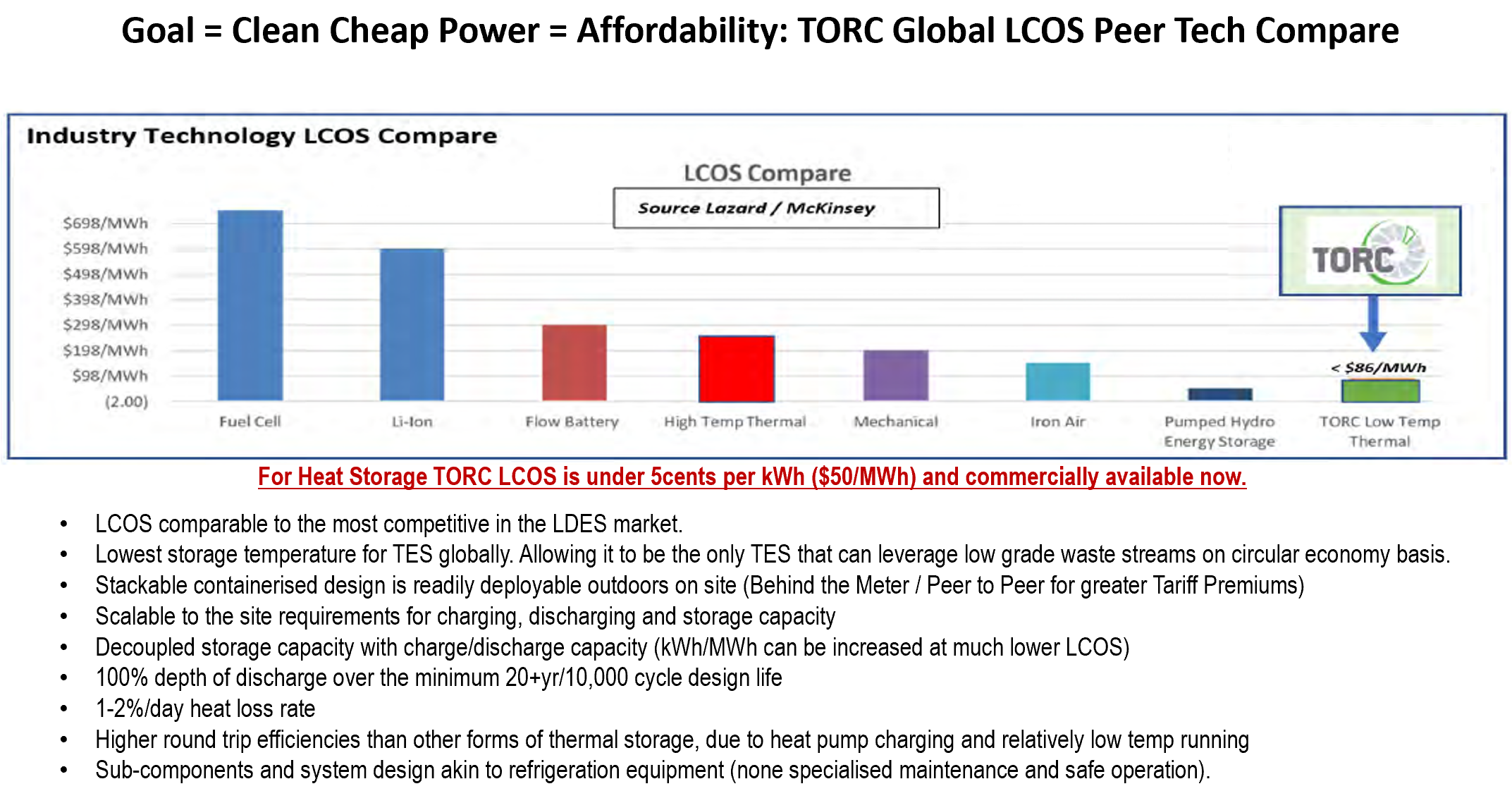
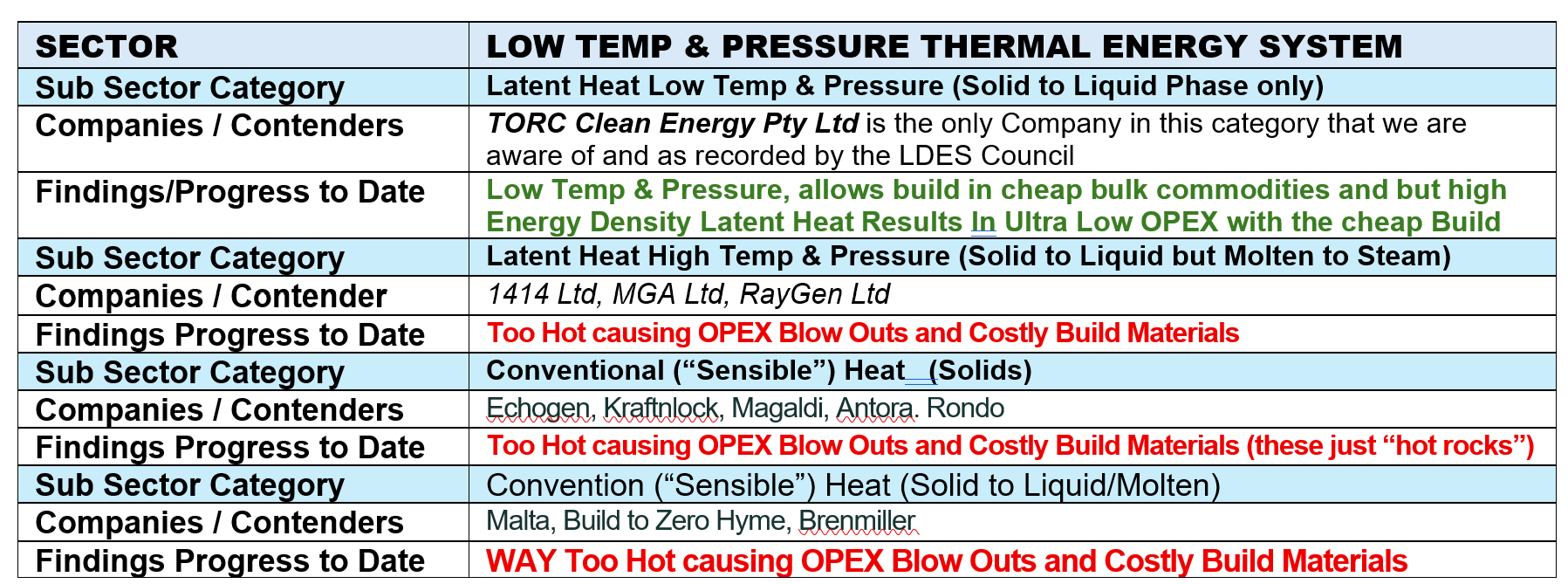
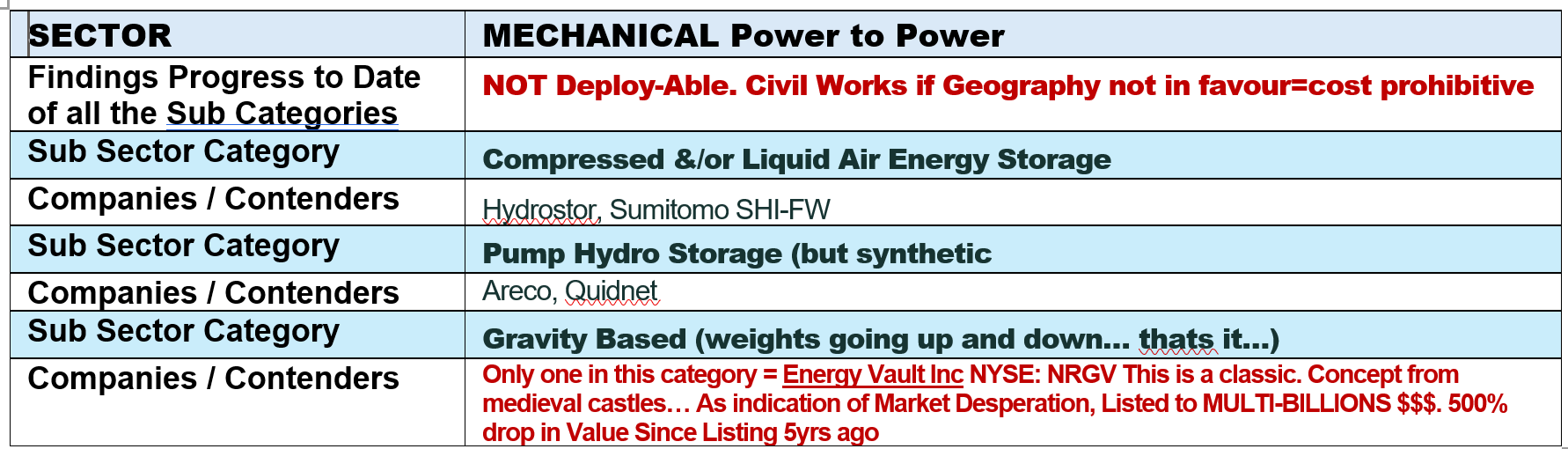
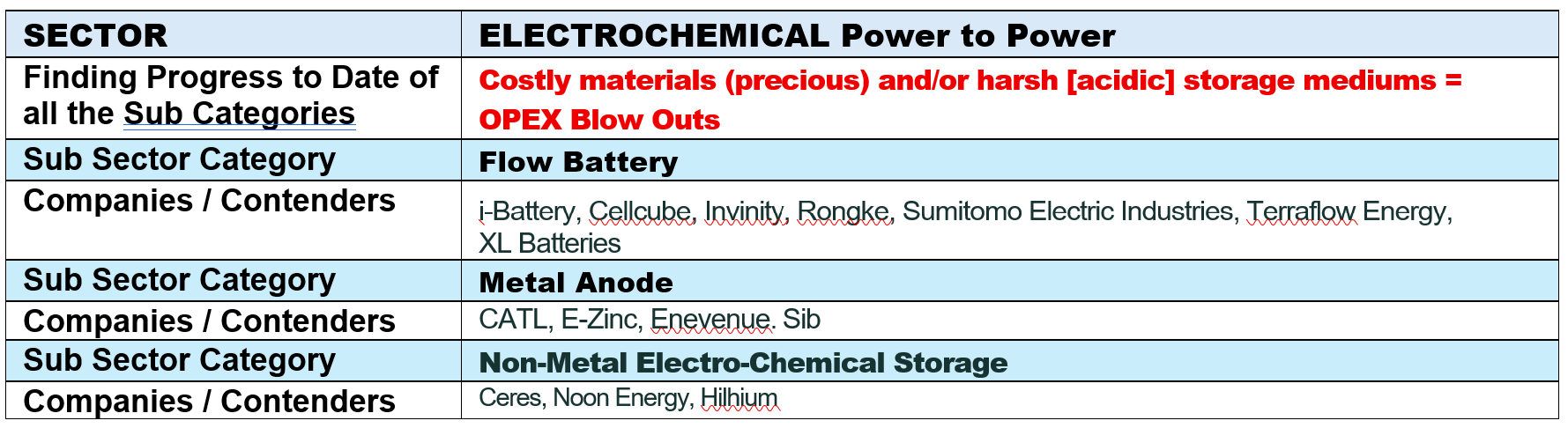
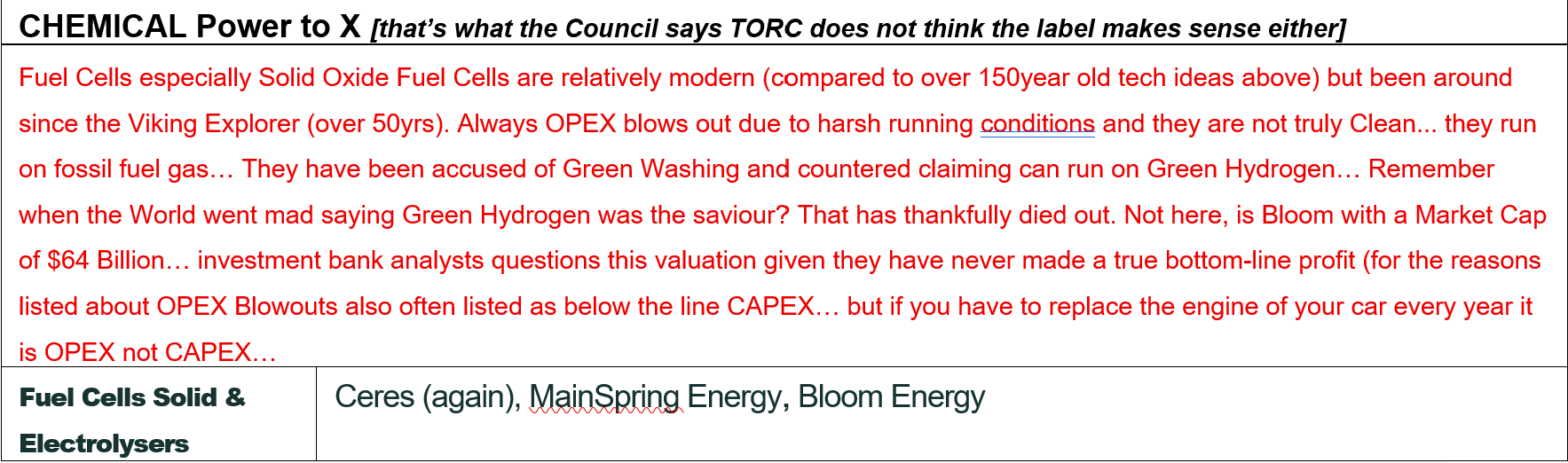
Below Table presents the LDES Council list of contenders (the only closest Peers to TORC - all already dropped minimum $100 MILLION into non-commercial ventures… some BILLIONS $$$ ….
….Table summarises where they fall short…
Overall Comment of the below contenders and TORC’s unique position of sole viability: Given the desperation for affordable clean storage, the adage of, “if it was going to work it would have by now” applies to all of the below contenders. Whereas with TORC all its componentry has proven commercially viable (and bottom line profitable) for the last 20 years. The test will be in its integration. However, all bench tests, University Technical Reviews in 3D simulation models and 3D AI modelling support our Claims and Plan.
TORC due diligence of its viability includes Peer Review of our models by the Australian Government’s Australian Renewable Energy Agency “ARENA” who carried out detailed Review resulting the $7.0 MILLION Grant Award. Academic Peer Review was also carried out by the Royal Melbourne Institute of Technology “RMIT”
Most Contenders have already burnt through hundreds of millions of dollars with no commercial product and use basically tech that is over 100 years old. Others that have listed, due to the desperation on Market Need and consequential hype, rose to multi-billion-dollar valuations only to see 1000% drops as time and no result passed. Not one of the below has a truly commercial product.
TORC maintains with only less than a $10.0Milion investment, it can have a commercial working product.
CAVEAT: Below commentary is TORC’s Opinion and not a claim of fact, we welcome our peers / colleagues in this noble quest to correct us.
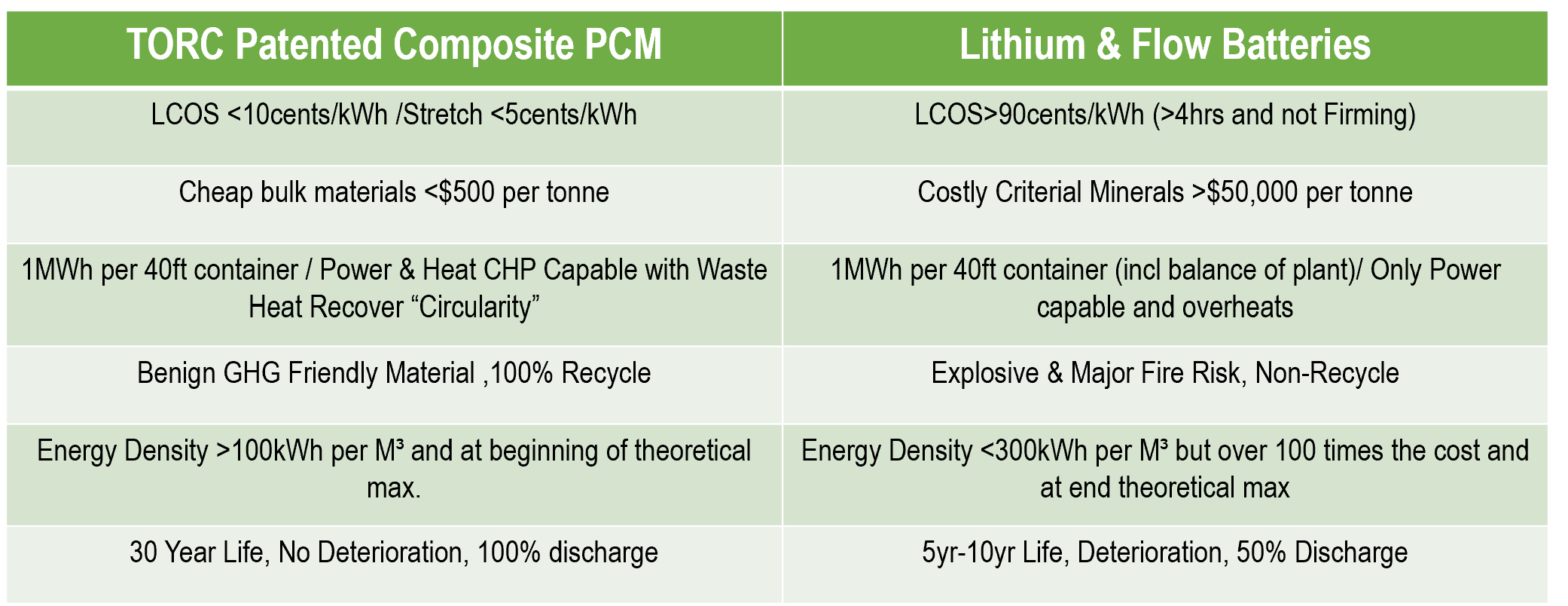
THE PROBLEM WITH LI-ION BATTERIES (that never seems to be mentioned and they continue to be listed as a solution)
Li-Ion Batteries are NOT LDES Storage and by their nature far too Costly
It is staggering that this needs to highlighted as it is obvious by Li-Ion Battery physical nature and expensive material composition but Governments still refer to them as a solution and they are responsible for Grid Prices in Australia rising 500% in the last 20year of suborn use. While the main cause in fairness is a broken Variable Renewable Energy Generator (because its Variable not On Demand), Li-Ion Batteries are continued to be referred not just as a solution but at a saviour.
As empirical corroboration, In States that have endorsed Li-Ion Batteries as their saviour, Li-Ion Battery Companies take over 25% of Grid Revenue but only provide 1% of Generation.
Just to be clear
Li-Ion Batteries are not Storage (that to be Storage needs to be Long Duration)
The LDES Council rightfully do not include Batteries, simply due to the physics of the technology that does not allow a de-coupling of Energy to Power.
De-coupled Storage is like Pumped Hydro - the Capacity (MWh) is the Turbine that is driven by the force of the water and gravity from the drop. But the Potential Energy being stored (MWh) is the water in the Dam. If you want to increase storage (>MWh), there is little cost, just add more water. And there is certainly no impact on the Turbine or anything that needs to be done to them. There is a total De-Coupling. This is not the case with Li-Ion Batteries, in fact the opposite. If you want to increase storage in a 1MWh Battery to 2MWh, you have to buy the entire system again.
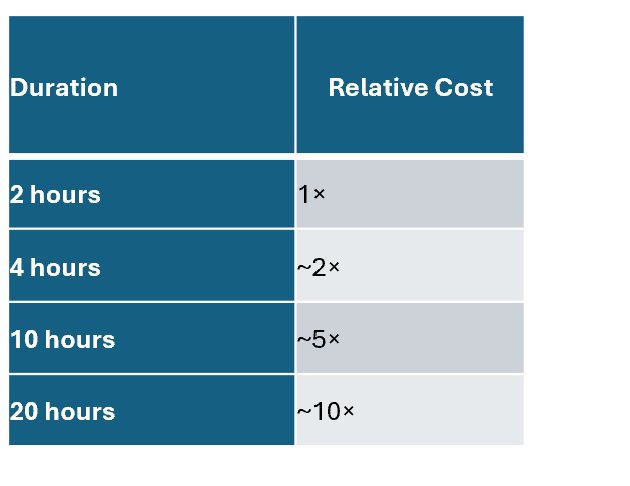
If it is NOT De-coupled it is NOT Long Duration Storage (spoiler alert Li-Ion Batteries are not Decoupled but linear in energy duration… that is why they are called batteries. Energy Duration (MWh) needs to be able to be ramped up at little cost – like the said ubiquitously proven Pumped Hydro (but not deployable) want more energy just add water.
Whereas Batteries are linear and coupled if you want to increase duration (kW to [X]*kWh) you need to buy the entire system this leads to: